


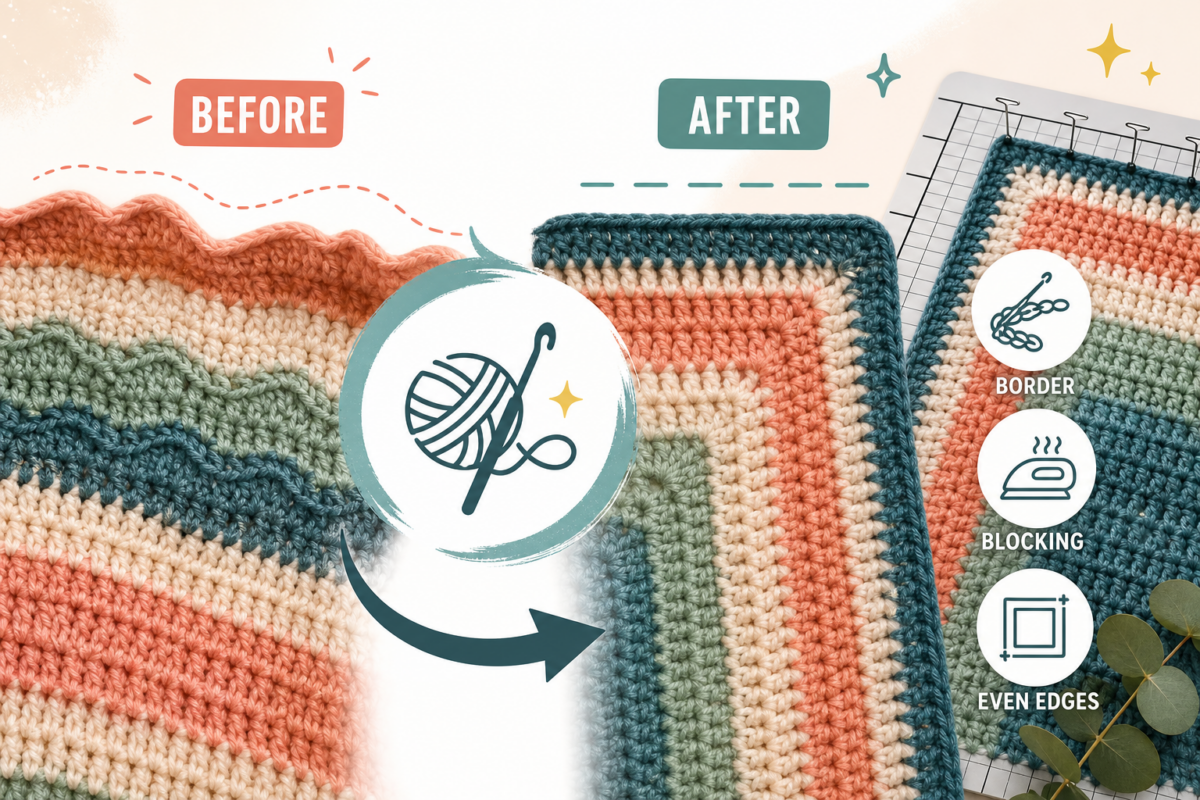
You finish the last stitch, set your hook aside, and step back to see your new crochet blanket. But instead of sharp sides and neat corners, you notice wavy edges, bulges, or a shape that won’t stay flat.
That first look can feel discouraging—I’ve been there myself. But you don’t need to start over or stash your project away.
To fix uneven edges on a crochet blanket, add a single crochet border: work 1 single crochet for each single crochet row, 2 for each double crochet row, and put 3 single crochets in every corner. Where the edge dips, switch to taller stitches.
Before starting, count and correct your edge stitches. After the border, block the blanket to set it flat.
With a little patience, you can save your project and sidestep these problems next time.
A lot of crocheters wonder why their blanket sides end up wavy or crooked. Usually, it's a mix of uneven stitch counts, tension shifts, or small mistakes at the row ends. It's easy to add or miss a stitch at the start or finish of a row, especially if you're unsure about counting the turning chain.
Those small errors add up quickly. Even one extra or missing stitch per row—repeated over dozens of rows—can throw your whole blanket off. Sometimes the trouble starts when you change your mind about counting the turning chain as a stitch halfway through, which can make one side longer than the other.
Tension matters too. If your grip changes, the edge might pucker, flare, or curve.
I remember making my first big blanket; the first few rows were way tighter than the rest. The sides started bowing, and no amount of tugging could straighten them out.
What Should You Do Before Fixing the Edges?
Before grabbing your hook to add a border, check the base fabric. Start by counting the edge stitches across several rows, both in the middle and at the ends.
Compare your counts to the pattern if you have one. If you find extra or missing stitches, fix those areas first.
If the edge problem is small, use a yarn needle and matching yarn to add or remove a stitch at the edge so it blends in. For bigger bulges or gaps, unravel a few rows and redo them, making sure the stitch count is correct. Just covering up major problems with a thick border won’t solve them; big bumps or dips will still show through.
Dica importante: Take care of major stitch count or shape problems before adding a border. Borders work best when your blanket is already close to even.
Once your stitch counts are fixed, mark the first and last stitch of every row with a stitch marker. This simple step helps you keep your edges tidy while adding the border and on future blankets.
What’s the Most Reliable Way to Crochet a Border for Straight Edges?
A single crochet border is the method I turn to when I need to even out the sides. Start at any corner with a slip stitch.
Along the sides, work 1 single crochet for every single crochet row and 2 for every double crochet row. This keeps things level and avoids puckering or stretching.
At each corner, make 3 single crochets in the same stitch. This lets your blanket turn smoothly and keeps the corners flat.
Some crocheters prefer to do 1 single crochet, chain 1, and another single crochet at the corner. Both ways work—use whichever feels better in your hands.
If you spot a dip along the edge, switch to a half-double or double crochet for 1 to 3 stitches in that area. This adds height and fills in the low spot. For wavy edges, alternating single and half-double crochets can help even things out.
Work about 6 inches of border, then lay the blanket flat to check for ripples or puckering. If the border waves or ruffles, you probably added too many stitches—pull out that section and redo it with fewer. If it feels tight and pulls in, add a few more stitches until it relaxes and lays flat.
How Can You Prevent Uneven Edges While Crocheting?
The best fix is to avoid the problem as you go. A few habits make a big difference.
The easiest: use stitch markers at the first and last stitch of each row, especially on big projects or if you’re new to blankets. This helps you spot missing or extra stitches right away.
Decide at the start whether you’ll count the turning chain as a stitch, and stick to it for the whole blanket. Changing your approach halfway through almost guarantees one side will grow longer than the other. Patterns differ—some count the chain, some don’t—but consistency is what matters.
Count your stitches at the end of each row, at least for the first several inches. Once you can spot the edge by sight, you might not need to count every time. If you do find a mistake, fix it right then—it’s a lot easier than realizing 50 rows later that your rectangle has turned into a trapezoid.
Resumo rápido: Mark the ends of every row and keep your stitch count steady as you work. Stick with your turning chain rule from start to finish for square edges.
What If the Border Still Looks Off?
Sometimes, even after careful prep and a neat border, something still feels wrong. If your border ripples or flares, you’ve likely added too many stitches. Just pull out that section and redo it with fewer, laying the blanket flat every few inches to check.
If the border is tight and pulls the side inward, add more stitches in those spots. Checking every 6 inches or so really helps—don’t wait until the very end to catch problems.
Corners can be tricky. If they curl or pinch, try adding an extra single crochet or a chain in the corner. The goal is to get crisp, flat right angles—if it curls, give it a bit more room.
Still seeing dips or valleys after these tweaks? Swap a single crochet for a half-double or double crochet in those low areas. The taller stitch helps the border match the blanket’s natural shape.
Does Blocking Actually Straighten Crochet Edges?
Blocking can take a blanket from homemade to polished. After finishing your border, lay the blanket out flat and gently shape it with your hands. Pin the corners and sides if you want sharp lines, or just press it into shape if your yarn isn’t good for pinning.
Mist the blanket lightly with water or use steam—always check your yarn label first—and let it dry flat. This helps set the stitches, smooth minor ripples, and keeps the edges in place. I've seen wonky blankets come out looking crisp and even after a good block.
Blocking won’t fix big underlying problems, but combined with a straight border, it gives your blanket a professional finish. Even if you’re doubtful, give it a try once and see the difference for yourself.
Getting straighter edges isn’t just about covering up mistakes. It’s about spotting what causes them, fixing the root, and building habits that keep your blankets tidy from the start. Careful counting, a well-planned border, and a good block really do pay off.
Have you tried fixing wavy or crooked edges on your blankets? What tips or challenges came up for you along the way?